
September 30, 2022
It dawned upon me one day that I should construct a crossword puzzle. Exactly what piqued my interest is hard to describe in one word, but it goes something like this: after doing the New York Times and Universal daily crossword for over two years and having solved about 3000 puzzles, I wanted to create one. In the first part of my crossword journey, I described how I encountered this wonderful pastime and wanted to promote it for my lovely readers, illustrating the myriad forms, shapes, and themes the puzzles present themselves, as well as tips on solving them. In the second part, I elected a more intimate route and told my backstory on how this newfound hobby became my steadfast companion during times of solitude. For this third part, I want to share my motivation to undertake the next chapter of my crossword experience of constructing a puzzle and the ups and downs along the way to finally realizing my dream. This has been an eye-opening experience for me solely rendered possible by the wonderful support and collaboration I received along the way, of whom I will give shoutouts throughout the blog.

September 27, 2022. This date is both a destination and a starting point. It's a destination because it marked the culmination of months of brainstorming and editing to create my debut crossword puzzle, finally to be published by Universal Crossword and seen through various media outlets that it syndicates, including The Boston Globe, my home market newspaper. However, it's also a starting point because I vowed to make many more puzzles after this, for the sole reason that the initial journey had been so memorable and rewarding. It was everything that I expected when I wanted to make a puzzle, and more.
May 10, 2022. This date is just a starting point, and a mundane one at that. This is the day that I decided I will make my own crossword puzzle. As aforementioned, what prompted me to take this leap is hard to pinpoint. Perhaps it was a switch inside my heart, after completing another daily crossword from Universal that the thought of "I'm on the sideline for too long" crept into my head. Or perhaps, after two years of looking at Universal Crossword daily, I figured to bring this thing to full circle. After all, I probably just completed my 1000th puzzle after discovering it for the first time in The Boston Globe newspaper at my workplace that one time... Although I started seriously challenging myself to my devoted hobby when I subscribed to New York Times Crossword, my initial contact with American crossword puzzles was with The Boston Globe. And so, on a typical day in May of this year, I decided to cross roads with crosswords once again in the newspaper that started it all, but instead of enjoying the fruits of others' labors, this time I would grow my own.
Beethoven's Piano Concerto No. 4 in G Major (Op. 58) opens its first movement with a 5-bar piano solo before the orchestra kicks in, breaking tradition for piano concertos at the time. That short piano passage has been compared to an egg hatching into a curious being eager to explore an alien world upon its birth. That young explorer was me when I decided to construct my own crossword puzzle. Even though I had some previous knowledge on how a puzzle is supposed to look and having done a myriad of them enough to fuel some sort of inspiring ideas for themes, I still drew blanks at step zero when it came to actually creating a puzzle. I decided to do a themed puzzle, because I only needed to think of four themed entries and the rest can be easy words (I will explain in more detail later in a crossword construction tutorial). However, themes are more difficult than it first looks. What are "themes"? Well, themes are the souls of themed crossword puzzles. They usually consist of a revealer and a bunch of entries that seem common to the readers' eyes at first, but at some point, either through the revealer or through seeing enough entries, present themselves in an "Aha!" moment that (hopefully) brings a smile to solvers' faces. If the themed puzzle does that, it's a good puzzle, and...vice versa. For my very first attempt at a themed puzzle, my themes comprise of the following:
LIGHTNING FAST
WINDFALLS
RAINCHECK
WEATHER FRONT <-- The Revealer
This is after about three days of staring aimlessly at the air while my brain churned on random words in my head. The revealer here is "weather fronts" because it can be interpreted in two ways. The first way is its definition in meteorology--boundary between two different air masses. However, if you interpret it *literally*, it aptly describes the three themed entries, as all of them had weather terms at the front! As an added bonus, I even discovered that those weather terms are associated with storms, which is usually the result of two air masses colliding at their boundaries, i.e. weather fronts! Giddily, I googled a crossword making software, Crosserville, and got down to business.
I would later discover that the modern way of making a crossword puzzle is through the collaboration between human and machine. The machine is used, through software like Crosserville, to find fills to complete a puzzle, while the human is used, through their human-ness, to decide whether the fills are good enough or not. Both components are essential to completing the construction. Without the machine, a human could never, on a practical time scale, find the letters to make words that make the puzzle work. However, without the human, the machine would never understand if the filled words would bring a smile to solvers' faces, which is the most salient evidence that the puzzle is a good one.
Unfortunately for my first puzzle, I relied too much on the machine and not on the human. I was dazzled at the speed and efficiency in which Crosserville was able to fill the rest of the grid to complete the puzzle encompassing my themed entries. And I was darn proud of myself. Here is that final product:

I immediately proceeded to Email the finished product to the Universal Crossword editors, David Steinberg and Amanda Rafkin, eagerly awaiting their feedback and (being hopeful) their approval. What came back was a rejection--forget the fills, even the theme wasn't good enough! I was slightly dejected, but figured that since it was my first attempt, it was alright that the puzzle didn't get approved. My second attempt was this theme:
*COFFEEMAKER (11): Barista, e.g. (Coffee Maker)
*ADCONVERTER (11): Modern circuit found in most electronic devices (Analog-to-digital converter)
*SNAPCHATAPP(11): Ghost icon? (SnapChat app)
GREATFILTER (11): One possible explanation of the Fermi Paradox, and something that can be used by all starred entries in this puzzle?
I guess the above theme revealed my geeky personality. Drawing from a background of electrical engineering, I somehow came across this theme thinking about *filters*, not from your typical coffee maker but rather from those found in digital signal processing. It dawned upon me that there could be many interpretations of filters, and that could make for a great theme. So I got busy again on the machine:

Another rejection. Both AD Converter and Great Filter are too esoteric for the general audience to enjoy. I stopped thinking about crossword puzzles for the next three weeks.
On one April morning, I came across a tweet by a crossword constructor whose name I've seen popping up several times on New York Times crossword puzzles--Ross Trudeau. In that tweet, he was seeking for several volunteers to solve and provide feedback on a new puzzle he was constructing. I gladly accepted the request, since when do you get to edit puzzles for NYT Crossword constructors on a daily basis? I had a blast test solving Ross's puzzle and he apparently appreciated my feedback, which was nice.
Two months later, on one June morning, I saw another tweet by him, this time celebrating his 50th(!) NYT Crossword publication. On a whim, I DMed him:
Hi Ross, congratulations on your recent crossword publications and 50 crosswords for NYT. I would like to gather some advice as I have recently decided to construct crosswords after solving many of them as a fun hobby...if you don't mind and are interested, I can have you take a look at my first couple attempts at making crossword puzzles (themed) and get some valuable feedback. Thanks!
I did not expect him to reply to me, but not only did he reply, he reviewed my previous submissions. Not only did he review my previous submissions, he also didn't mind spending an hour on Zoom teaching me the various tools and tricks for constructing a crossword puzzle. And not only did he spend the time Zooming to me all the crossword construction tips, but he also wanted to collaborate with me on the Universal Crossword puzzle.
I was beyond touched. I didn't expect someone of his pedigree in the world of crossword to spend the time collaborating with a novice, but here we were, eager to make something out of almost nothing. You see, the only ember left from the burnt-out flame that was my first two attempts was that David and Amanda was still intrigued with the *filters* idea and wanted me to explore a bit more. I presented this seed of a theme to Ross, revised from last time, like so:
*Purifying Water (14): Using Brita, e.g.
*Editing Photo (12): Using Instagram, e.g.
*Making Coffee(12): Using Keurig, e.g.
Applying a filter (14): What you are likely doing in the starred entries
Ross liked the theme, but pointed out several shortcomings:
The back and forth continued, and ideas flowed through layers of metaphorical filters until one approved theme emerged:
August 15, 2022.
Hi David!
Thanks so much for continuing to think on this one for us! After seeing everything and thinking it over, we think we're ok to go with this set:
SNAPCHAT PICS 12
INNER THOUGHTS 13
COFFEE GROUNDS 13
APPLY A FILTER 12
Thanks for sticking with us, and feel free to get started on a grid!
Best,
Amanda
Explanation of the final theme:
One of the most valuable lessons I learned from Ross was the integration of that human-ness into the final version of the puzzle. Recall how I noticed the art of making a crossword is about the collaboration between the human and the machine. The machine finds the words to fill the grid, and the human decides whether those words will put a smile on solvers' faces. There is a term to measure such quality: smoothness. The smoothness of a crossword puzzle is how well words in that puzzle, when filled out as entries by a human solver, satisfies that solver. Obscure words such as "Ionesco", as the machine found for one of my previous attempts, would not appear "smooth" for a human solver. On the other hand, simple words with nicely-worded clues will get the solvers into a groove and the ink will flow from their pens like a well-oiled machine, and in no time, they will finish the puzzle, feeling satisfied. The key to injecting such smoothness into the puzzle is, as a human constructor, look at the filled words and ask yourself, "will you be satisfied solving the puzzle, if those are the entries?".
In order to make the puzzle smooth, ironically the starting point is to exploit the machine. When trying out different configurations for finding a grid with smooth entries, you can ask the machine to only consider words above a certain "smoothness score". Then, given the wordlist the machine uses to find words, it will only look for words above that score. It is hard to quantify what that score indicates, but you'll see it when you see it, simply by comparing scores for words like "Ionesco" (30) to words like "Appeal" (60). In a later section, I'll tell you how to set the filter in Crosserville.
After letting the machine find several suitable grid fills, the next step is to decide on which ones the solvers will enjoy the most. For this, always listen to seasoned crossword constructors like Ross and the puzzle editors, as they have the most experience on making the smoothest puzzles. For my debut puzzle, I am grateful for David, Amanda, and Ross for providing invaluable feedback on the final grid fill and making the puzzle as delightful as possible.
Here is the semi-final version of the puzzle:

Once the grid is filled, the final step is cluing. For that, crossword software such as Crosserville can offer past clues that you can base, or you can create your own. This is the part where you will have the most creative liberty, so have fun with it. For themed puzzles, the joy is in the themed entries, so be sure to have original clues for those!
August 17, 2022.
Thanks so much, you two—I'm happy to say this is now officially a yes! I've added the puzzle to my queue for next month, and I'll be in touch soon with accounting forms for you, David.
Hope to see more from both of you soon,
David (Steinberg)
September 27, 2022.

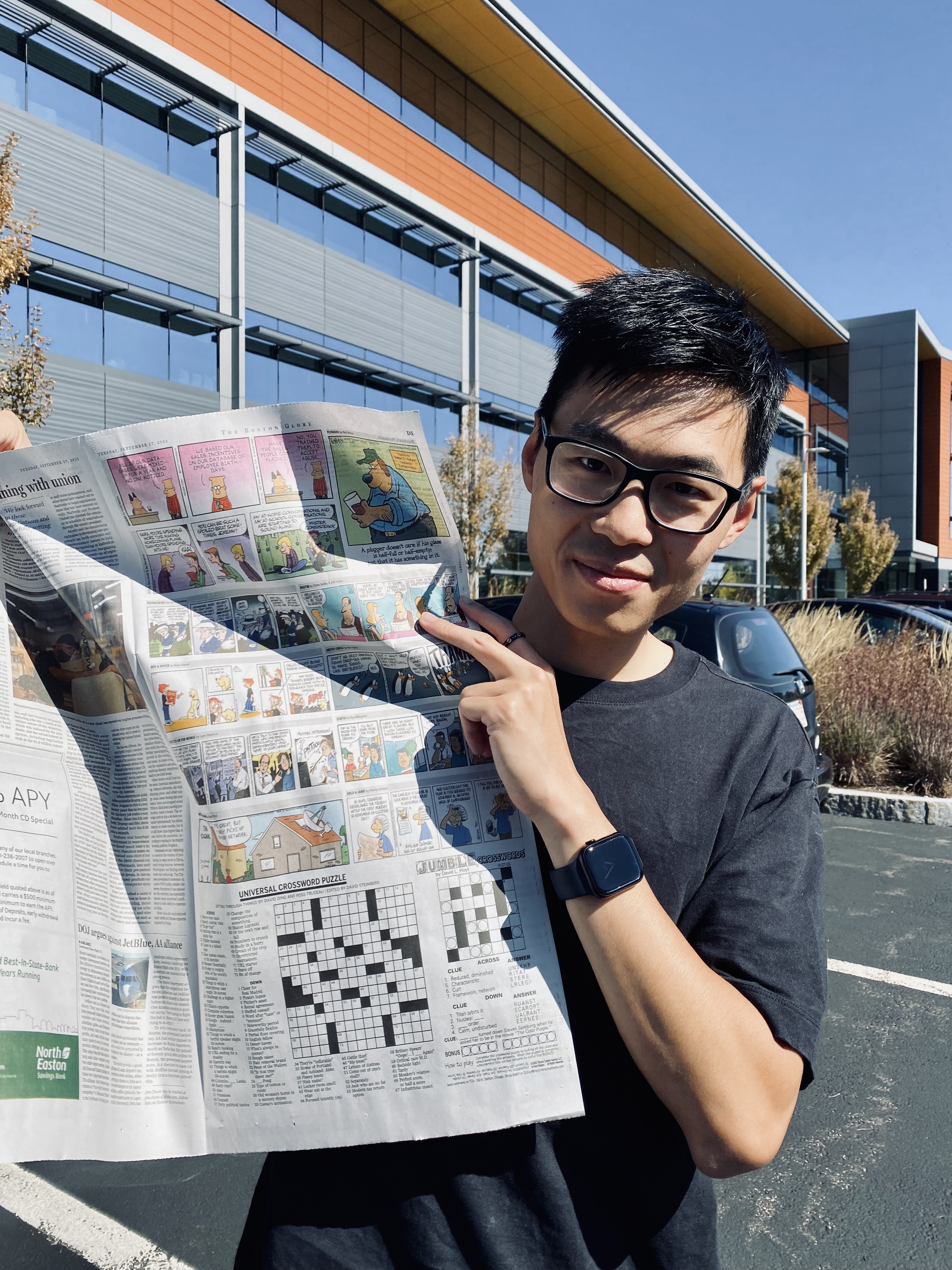
I am grateful of the lessons learned in making this crossword puzzle and the unforgettable experience from this journey. The first thought I had after I published my debut puzzle, looking back at everything that was built towards that point, was that I want to encourage my readers to also try making their own crossword puzzles. However, I want to share the lessons so that my readers don't have to feel lost at step zero, so I am taking this act as a tutorial to tell everyone a thing or two to get started.
First, purely based on my experience, I recommend using Crosserville. It is a free, online crossword construction software that anyone can use. The rest of the instructions will be based on Crosserville.
After creating an account, go to www.spreadthewordlist.com to download their wordlist. It is superior to the default wordlist on Crosserville in both size and scoring. For Crosserville, the file to download is the "spreadthewordlist.txt". Once downloaded, you can store it somewhere to be imported into Crosserville.
Before moving on, note the "scoring levels" section of the spreadthewordlist page, and see the different scores for words, as I described earlier in this blog.
In your Crosserville account, click on "Grid Builder" at the top right menu to go to the main crossword construction page. Click on "File-->New Puzzle" to create a blank puzzle. Give it a title, have it 15 x 15 which is the standard size for a weekday puzzle, and set the "Symmetry" to Rotational Symmetry.
Note on symmetry: One of the conventions of a crossword puzzle is that it must be rotationally symmetric. This is for aesthetics as well as the requirement for most major crossword puzzles. Other symmetries or asymmetrical designs must be related to a particular theme.
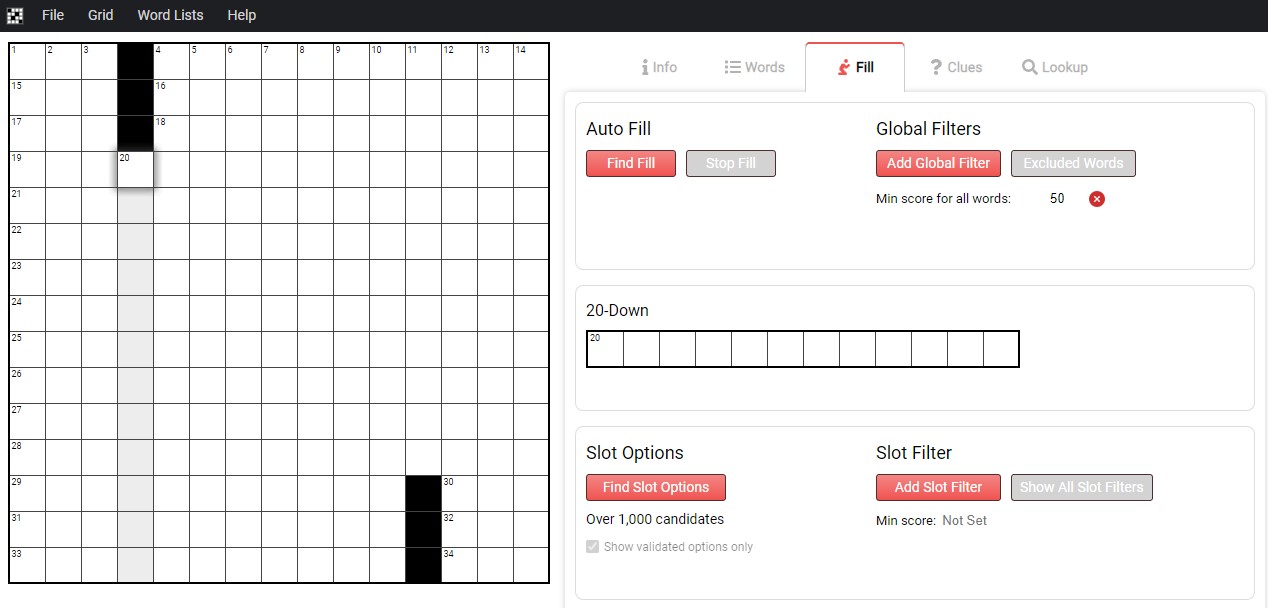
Go to "Word Lists-->Manage word lists..." to import your "spreadthewordlist" text file and select that one as your wordlist. Click on the "Fill" tab to "Add Global Filter" by filling in the minimum score for all words, which should be 50.
On the actual grid, you can click on any square and press the "dot (.)" key to make that square black, i.e. split the grids. Since the grid has rotational symmetry, making any square black will automatically make its corresponding symmetric square black. If you have themed entries, those entries must be symmetrically placed. For example, if there is a major theme entry three rows down from the top of the grid, then there must be another theme entry in the same position three rows up from the bottom.
Those are the basic steps to get yourself started constructing a crossword puzzle!
Always read the submission guidelines for a crossword puzzle before starting your construction. Here are the guidelines for Universal Crossword.
Basic rules for constructing a crossword.
Advanced tips and sage advice.
More great tips from New York Times Crossword guidelines.
Here are more personal tips from my experience
a side by side of my first 50 published puzzles and my most recent 50 puts a pretty fine point on my evolving priorities as a crossword writer pic.twitter.com/Ow6hCSCOFY
— Ross Trudeau (@TrudeauRoss) August 31, 2022
I want to take this opportunity to thank a bunch of people throughout my debut crossword journey for making it such an unforgettable experience. First, I would like to thank my mentor and collaborator Ross Trudeau (@TrudeauRoss) for taking the time patiently explaining to me the ins and outs of constructing a crossword and collaborating with me for my debut. This has been truly special, and I feel very lucky to have met you along the way. I would also like to thank Universal Crossword editors David Steinberg (@dsteinberg49) and Amanda Rafkin (@AmandaRafkin) for their tireless work editing our puzzle. After my debut crossword was published, I am deeply grateful for everyone who tried it out and told me that they enjoyed it. At the end of the day, I guess I found out why I wanted to create my own crossword puzzle--so that I can have a chance bringing some joy to those that treasure this delightful pastime.
My Universal Crossword debut with @TrudeauRoss! Thanks @dsteinberg49 @AmandaRafkin and Ross for making my dream come true! 🙌 #UniversalXW #Crossword pic.twitter.com/KuJY2YHwuD
— David Ding (@DavidYiweiDing) September 27, 2022