September 6, 2026
Around early 2025, a local game store (LGS) opened near where I lived. At the time, as a Magic enthusiast, I was really only able to enjoy the game online through Magic: The Gathering Arena. I occasionally went to other game stores much further away just to enjoy some good old paper Magic in the style of commander as I have built up a few decks throughout the years. However, the opening of an LGS that I can finally call home became the turning point of my hobby, as I discovered a new, competitively sanctioned format that elevated my appreciation for this game. It's called "limited".
Limited, as it turns out, is an entirely new and exciting way to play Magic for me where you build your deck DURING the competition from a limited card pool (hence the name), often from a dedicated set, and play against others. The key is that you don't know what cards you will be working with ahead of time, and during play, you won't know exactly what your opponents have cooked up. The mystery and the ever-changing scenarios I encounter playing limited is one of my big draws towards this format. The format has two main flavors, for which I will consider homogeneously for this blog post. They are sealed and draft. Sealed is a limited format where you show up to the event, get handed six booster packs, open them, and make a deck from it. This is usually done for pre-release events for players to get to know a new set. Draft, on the other hand, works by you getting handed three booster packs while seated with others around a table (called a pod). Players open packs one at a time, taking one card from the pack, passing it to their left/right/left across three rounds (one for each pack), build a deck from the cards drafted, and battle it out for supremacy. Unlike sealed which typically is run during pre-releases, draft occurs much more regularly and usually is a staple of Friday Night Magic (FNM).
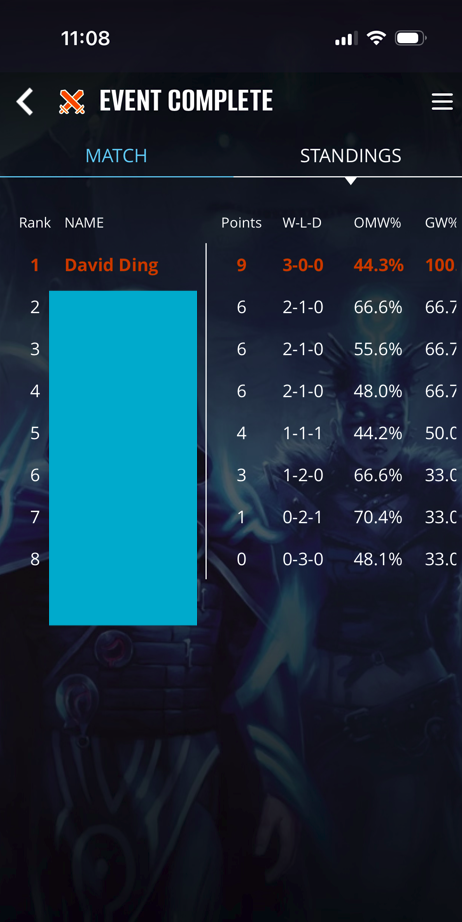
A few other terms here: a "trophy" is when you finish 3-0 in your LGS FNM draft, and therefore topping the standings and getting that coveted first place prize (usually top store credits + promo packs). Why 3-0? LGS Drafts usually consist of three rounds, each round being a best-of-three contest. The pairing is swiss, meaning players with similar records are matched up in the next round. Since a typical pod size is eight players, and \(8 = 2^3\), if you do the math, a 3-0 record stands alone. Exhibit A (totally not bragging):
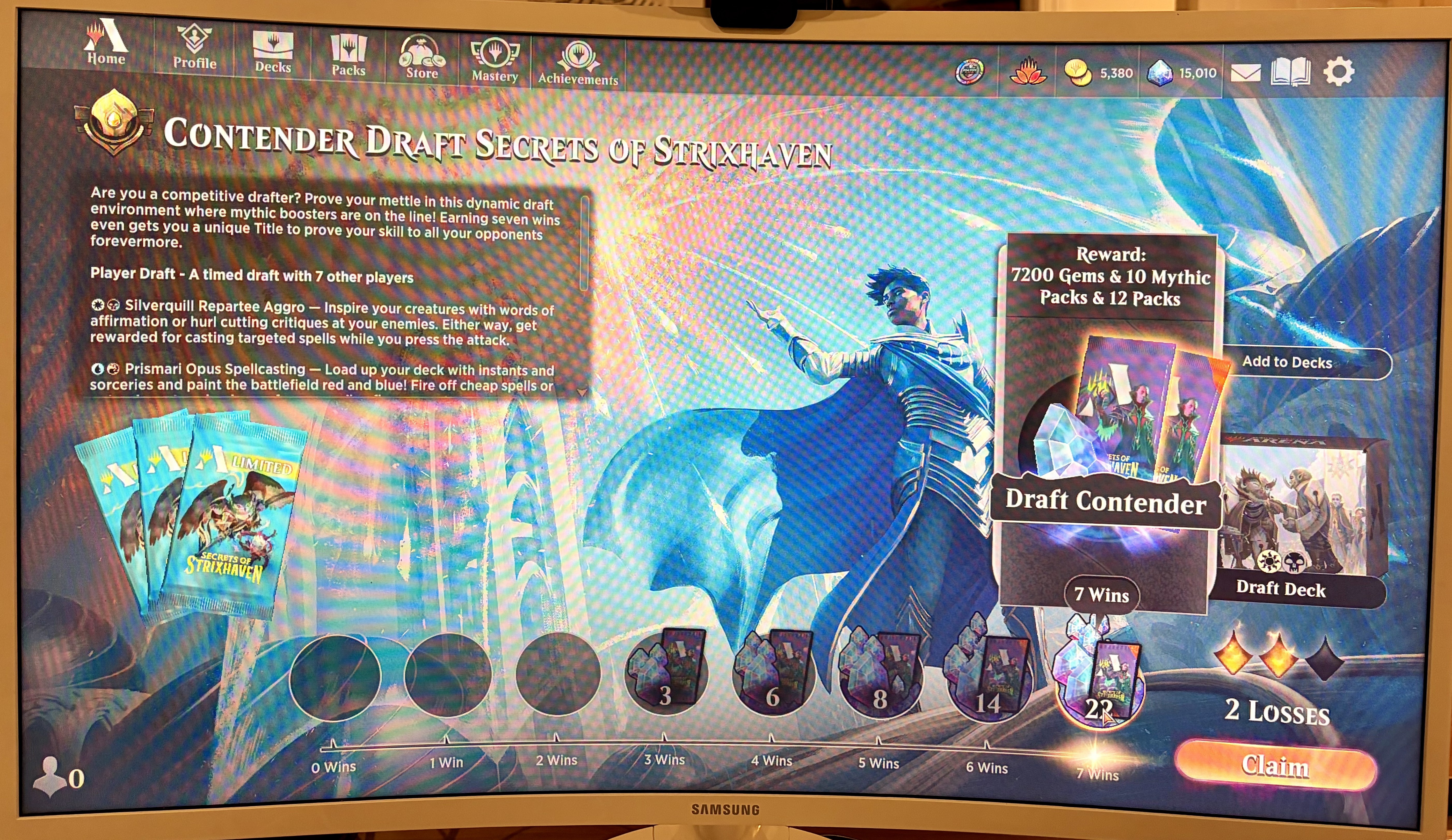
On MTG Arena, a "trophy" is awarded when you finish with seven wins before three losses, as seven wins is the maximum you can win in a draft (Best of One here) and three losses eliminates you. So if you finish an event 7-0, 7-1, or 7-2, you get a trophy. Another totally-not-bragging example:
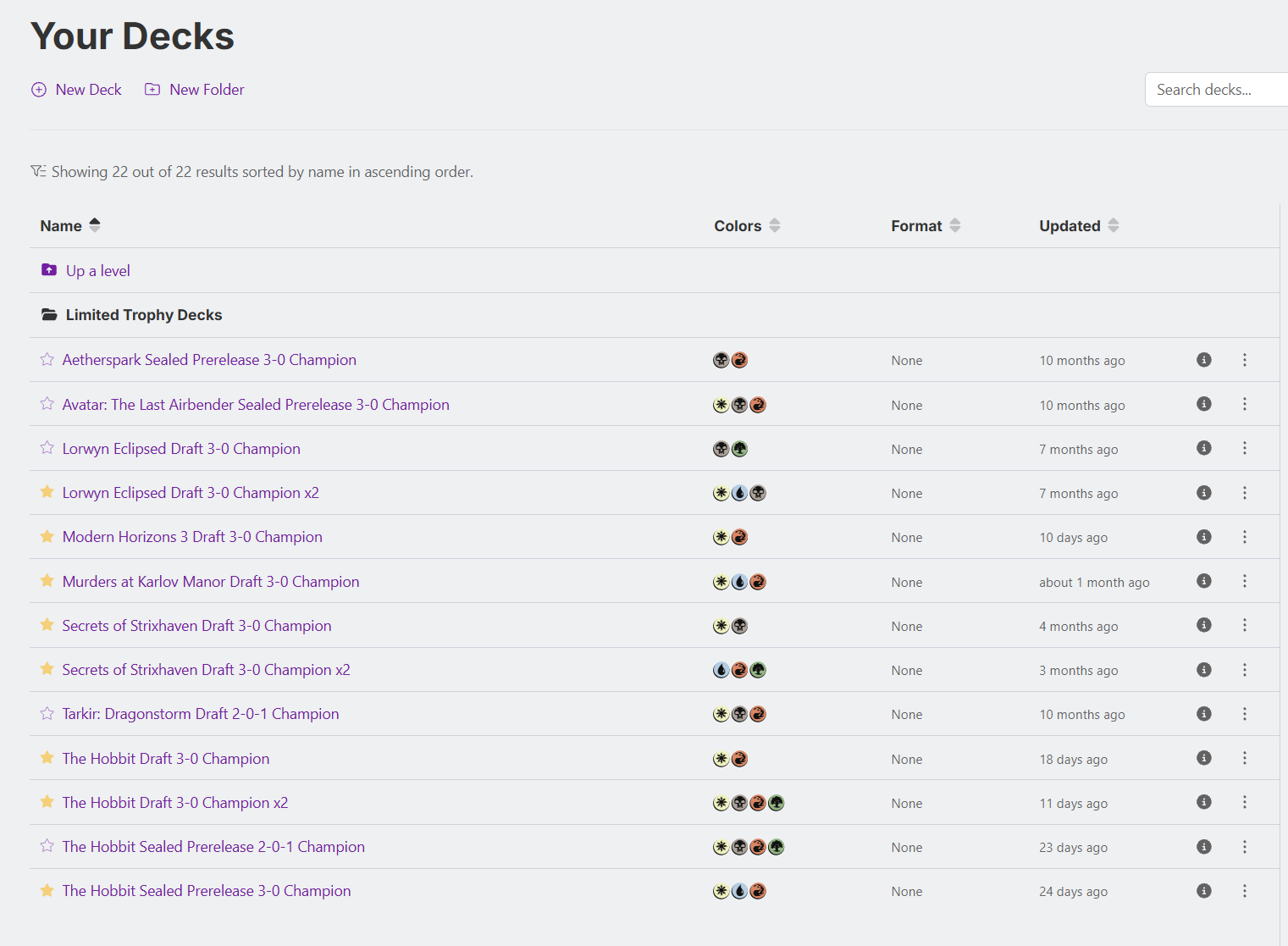
Alright, but enough about online play. While my passion for limited has extended digitally since I started drafting at my LGS, my stance is that meaningful limited play is with paper magic, played with other Magic enthusiasts, live in person at FNM Drafts hosted by my LGS. After a string of successes, I recorded all my trophy decks on moxfield here:
I wanted to write this blog post because one day I just fed my thirteen trophy decks at my LGS into an Excel sheet and did some analysis to see if I can find some patterns:
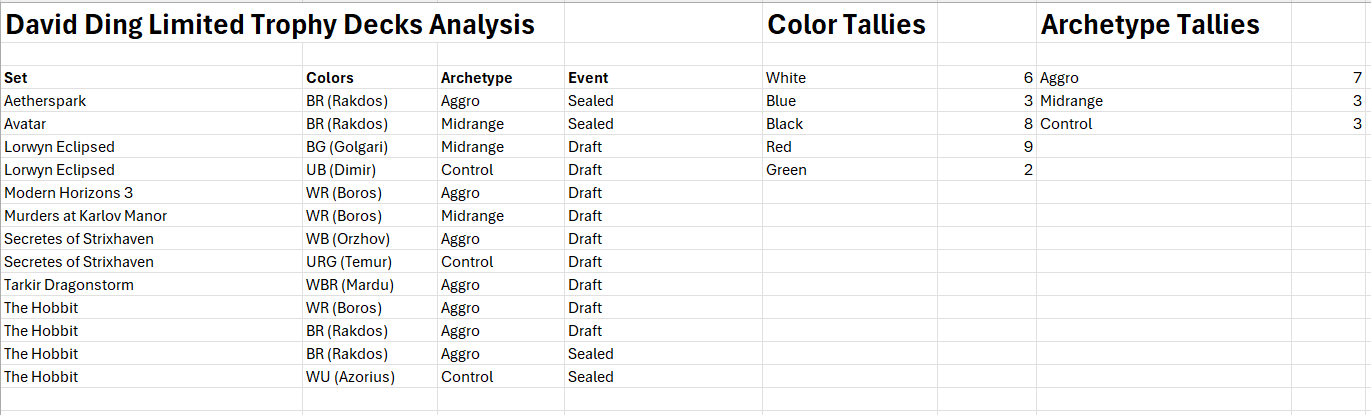
Yes, from the above spreadsheet, I analyzed my trophy decks by color distribution and archetypes. More on that in a second. Here is the table in bigger font for your viewing pleasure:
| Set | Event | Colors | Archetype |
|---|---|---|---|
| Aetherspark | Sealed | BR (Rakdos) | Aggro |
| Avatar | Sealed | BR (Rakdos) | Midrange |
| Lorwyn Eclipsed | Draft | BG (Golgari) | Midrange |
| Lorwyn Eclipsed | Draft | UB (Dimir) | Control |
| Modern Horizons 3 | Draft | WR (Boros) | Aggro |
| Murders at Karlov Manor | Draft | WR (Boros) | Midrange |
| Secrets of Strixhaven | Draft | WB (Orzhov) | Aggro |
| Secrets of Strixhaven | Draft | URG (Temur) | Control |
| Tarkir Dragonstorm | Draft | WBR (Mardu) | Aggro |
| The Hobbit | Draft | WR (Boros) | Aggro |
| The Hobbit | Draft | BR (Rakdos) | Aggro |
| The Hobbit | Sealed | BR (Rakdos) | Aggro |
| The Hobbit | Sealed | WU (Azorius) | Control |
| White | 6 |
|---|---|
| Blue | 3 |
| Black | 8 |
| Red | 9 |
| Green | 2 |
| Aggro | 7 |
|---|---|
| Midrange | 3 |
| Control | 3 |
For determining colors of the decks shown, I respected splashes as their own distinct color. However, I disregarded hybrid mana symbols. In other words, I looked at my mana base, and used that as the main indicator of my decks' colors.
For archetype definitions used, I deviated from the traditional sense of "aggro", "midrange", and "control" to be closer to that for limited. First of all, for each limited deck, I considered the set context in which the deck originated, and from there, what the archetype of the deck represented in that set. For example, while Orzhov color pairings typically don't represent aggro, for that Secrets of Strixhaven trophy deck in WB, representing Silverquill, it is absolutely an aggro archetype with the repartee mechanic. Hence, it is classified as an aggro deck.
Secondly, the tempo for limited is usually much slower than that for constructed, and hence if we use the traditional archetype definitions, almost no limited decks I'm showing would qualify as "aggro". Similarly, it is virtually impossible to draft a pure "control" deck in the traditional sense. Therefore, I had to "re-calibrate" and come up with the definition as follows:
Aggro: the game plan is to use creatures to beat down opponents from the get-go. Removals are almost exclusively to clear blockers.
Midrange: the game plan is to ultimately overwhelm opponents with board presence. Deck can choose not to focus on removal/counterspells as main interactions, but instead deploy creatures and eventually attack for lethal.
Control: the game plan is to be spell-slinging heavy in the early to middle game, primarily for drawing cards/removal/counterspells/flashing in utility creatures. Only when opponents are out of gas in the late game do I then deploy game-ending threats.
Another thing to note about finding patterns in my limited trophy deck analysis is that the raw data is organic. For sealed, you don't know what pool of cards you are going to get, and you cannot force your "favorite" archetype while disregarding the card pool. For draft, while forcing is possible, it's usually a terrible strategy and one that I never adopt. I always seek to draft the open lane. Therefore, whether it's sealed or draft, the eventual decks I build were completely dependent upon the randomized set of cards given to me. Therefore, the result and the patterns that emerge can be truly fascinating and meaningful. This helps me to reflect on what those trophy decks say about me as very little bias is present in the data.
What do we have here? Black and red dominate the color chart with white trailing close behind. Blue and green are completely under-represented here. On the archetype side, aggro dominates as it yielded more trophy decks for me than midrange and control combined. The two charts add up, as red is often the aggro color with sets after sets giving black the best removal. So imagine this: cheap creatures in red deployed early with premium removal in black to get the opponents' pesky blockers out of the way. The result is that I have been quite comfortable piloting aggro decks in limited all the way to that 3-0 limited trophy. Sometimes, sets produce premium removals in white, and red with its cheap damage-based removal is never too shabby as well. The end result is as follows: apparently, I am comfortable and proficient in piloting aggro decks, know when I'm the beatdown and how to establish the beatdown role, and when to fire off removal and finding the lethal line. Looking at the raw data and it agrees with this pattern: I've had plenty of success in Rakdos and Boros and even one Mardu trophy. Aggro abound.
Okay so that was the top-level analysis. However, let's look deeper here. I am especially interested in cases where control worked. I will go specifically into some of them as they bring back fond memories.
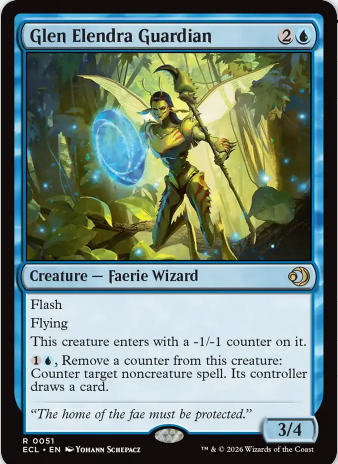
That one Lorwyn Eclipsed trophy deck in Dimir is arguably one of my most memorable decks. It was FNM Draft at my LGS, and I was fully aware that the five "kindred" archetypes for that set are: Selesnya Kithkins, Azorius Merfolk, Rakdos Goblins, Golgari Elves, and Izzet Elementals. As I browsed the cards that were passed to me, I noticed that there were quite a number of Faeries in Dimir colors with flash, along with bounce/counterspell/tappers, and I ended up with an off-color archetype: Dimir Faeries. Most cards in my deck are instants or flash Faeries (with flying of course), and my game plan was straightforward: control my opponents' boards by holding up mana on their turn. If they deploy threats, then counter/bounce. If they do nothing of value, then I flash in a Faerie. Either way, by the late game my opponents did not have much of a board while a swarm of Faeries threatened lethal in the air. I went 3-0. It was a nice draft. [Decklist here]
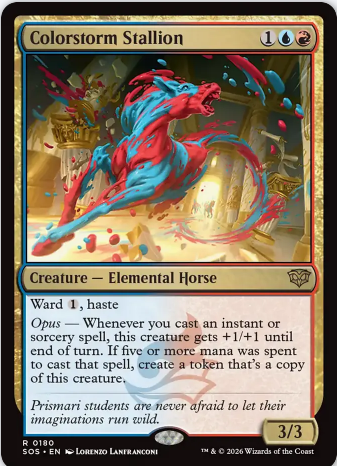
The other memorable deck I built firmly in the control category is the Secrets of Strixhaven Temur spell-slinger deck. The entire deck had only seven creatures, and six of them are mana dorks/utility creatures. Only the Colorstorm Stallion is used as one of the finishers/win-cons and even its role is tightly coupled with this deck's main game plan: sling some pretty big spells and win from there. When I played this deck, it was a roller coaster. If I didn't draw the right cards at the right time, then faster aggro decks would run me over. However, if I managed to stabilize, then ohh boy, let the fireworks begin. In those games I can tell you I had the most fun playing Magic in a long time and this includes commander! I also went 3-0 with each of the matches winning 2 games to 1 in the best-of-three format. [Decklist here]
So what do those trophy decks say about me? I have good limited fundamentals, and while I am quite comfortable and proficient in piloting an aggro deck, doing the math on damage and thinking about what answers my opponents can have to derail my plans, I can also play other archetypes. I especially enjoy a good spell-slinging control deck from time to time, especially if it pops off, as that is the fun of Magic: The Gathering!