April 28, 2026
This is the one-pager runthrough of my Basel problem proof using Fourier series and signal processing. For a more detailed exploration on this, please see my earlier blog post.
We seek to prove the Basel problem:
\begin{equation} \boxed{1 + \frac{1}{2^2} + \frac{1}{3^2} + \frac{1}{4^2} + \frac{1}{5^2} + \dots = \frac{\pi^2}{6}} \end{equation}
We show that:
\begin{align} \left\{\frac{e^{j\omega nt}}{\sqrt{T}}\right\}_{n \in \text{ integers}} \end{align}
is an orthonormal basis for periodic signals \(x(t)\) with period of \(T\).
Proof:
We let \(\phi(n) = \frac{e^{j\omega nt}}{\sqrt{T}}\). We have:
\begin{align} &\langle \phi_n(t), \: \phi_m(t) \rangle \\ \\ =& \int_{-\frac{T}{2}} ^ {\frac{T}{2}} \phi_n(t) \phi_m^*(t)\, \mathrm{d}t \\ \\ =& \int_{-\frac{T}{2}} ^ {\frac{T}{2}} \frac{e^{j\omega nt}}{\sqrt{T}} \frac{e^{-j\omega mt}}{\sqrt{T}}\, \mathrm{d}t \\ \\ =& \frac{1}{T}\int_{-\frac{T}{2}} ^ {\frac{T}{2}} e^{j\omega (n-m)t}\, \mathrm{d}t \\ \end{align}
Case 1: \(n = m\). In this case we have \(n - m = 0\) and so:
\begin{align} c_n &= \frac{1}{T}\int_{-\frac{T}{2}} ^ {\frac{T}{2}} e^{j\omega (n-m)t}\, \mathrm{d}t \\ \\ &= \frac{1}{T}\int_{-\frac{T}{2}} ^ {\frac{T}{2}} \, \mathrm{d}t \\ \\ &= \frac{T}{T} = 1\\ \end{align}
Case 2: \(n \neq m\). In this case we have \(n - m \neq 0\) and so:
\begin{align} c_n &= \frac{1}{T}\int_{-\frac{T}{2}} ^ {\frac{T}{2}} e^{j\omega (n-m)t}\, \mathrm{d}t \\ \\ &= \frac{1}{T}\left[\frac{e^{j\omega (n-m)t}}{j\omega (n-m)}\right]_{t = -\frac{T}{2}} ^ {t = \frac{T}{2}} \\ \\ &= \frac{1}{T}\left[\frac{e^{j\omega (n-m)(T/2)} - e^{-j\omega (n-m)(T/2)}}{j\omega (n-m)}\right] \end{align}
Recall that \(\omega = \frac{2\pi}{T}\), we have:
\begin{align} c_n &= \frac{1}{T}\left[\frac{e^{j\omega (n-m)(T/2)} - e^{-j\omega (n-m)(T/2)}}{j\omega (n-m)}\right] \\ \\ &= \frac{e^{j\pi(n-m)} - e^{-j\pi(n-m)}}{2j\pi(n-m)} \\ \\ &= \frac{\sin{[\pi (n-m)]}}{\pi (n - m)} \\ \\ &= \delta_{nm} \end{align}
Since \(n - m \neq 0\), first of all we are not dividing by zero, which is good. Second, since \(n\) and \(m\) are integers, the argument to the sine function is a multiple of \(\pi\), which means the value is always 0. This proves that:
\begin{align} \phi_n(t) &= \left\{\frac{e^{j\omega nt}}{\sqrt{T}}\right\}, \quad n = 0,\pm1, \pm2, \pm3, \dots \\ \end{align}
is indeed an orthonormal basis for periodic signals with period \(T\).
Now that \(\left\{\frac{e^{j\omega nt}}{\sqrt{T}}\right\}_{n \in \text{ integers}}\) is an orthonormal basis for periodic signals \(x(t)\) with period \(T\), we can form the Fourier series for \(x(t)\)
\begin{align} x(t) &= \sum_{n = -\infty}^{\infty} c_n \frac{e^{j\omega nt}}{\sqrt{T}} \\ \end{align}
For neatness, we can scale the Fourier coefficients \(c_n\) by \(\frac{1}{\sqrt{T}}\) so that the denominator of the above equation goes away:
\begin{align} x(t) &= \sum_{n = -\infty}^{\infty} c_n e^{j\omega nt} \\ \end{align}
And thus each Fourier coefficient \(c_n\) is simply the projection of \(x(t)\) and the \(n\)th basis function, scaled by \(\frac{1}{\sqrt{T}}\):
\begin{align} c_n &= \frac{\langle x(t), \: \phi_n(t) \rangle}{\sqrt{T}} \\ \\ c_n &= \frac{1}{T}\int_{-\frac{T}{2}} ^ {\frac{T}{2}} x(t) e^{-j\omega nt}\, \mathrm{d}t \\ \end{align}
We show that:
\begin{align} \frac{1}{T}\int_{-\frac{T}{2}} ^ {\frac{T}{2}} |x(t)|^2\, \mathrm{d}t &= \sum_{n = -\infty}^{\infty}|c_n|^2 \\ \end{align}
That is, the power of a periodic signal can be computed in two equivalent ways: in the time domain and in the frequency domain via its Fourier coefficients.
Proof:
\begin{align} \text{L.H.S} &= \frac{1}{T}\int_{-\frac{T}{2}} ^ {\frac{T}{2}} |x(t)|^2\, \mathrm{d}t \\ \\ &= \frac{1}{T}\int_{-\frac{T}{2}} ^ {\frac{T}{2}} x(t) x^*(t)\, \mathrm{d}t \\ \\ &= \frac{1}{T}\int_{-\frac{T}{2}} ^ {\frac{T}{2}} \sum_{n = -\infty}^{\infty} c_n e^{j\omega nt} \left(\sum_{n = -\infty}^{\infty} c_n e^{j\omega nt}\right)^*\, \mathrm{d}t \\ \\ &= \frac{1}{T}\int_{-\frac{T}{2}} ^ {\frac{T}{2}} \sum_{n = -\infty}^{\infty} c_n e^{j\omega nt} \sum_{n = -\infty}^{\infty} c_n^* e^{-j\omega nt}\, \mathrm{d}t \\ \\ &= \frac{1}{T}\int_{-\frac{T}{2}} ^ {\frac{T}{2}} \sum_{n = -\infty}^{\infty} \sum_{m = -\infty}^{\infty} c_n c_m^* e^{j\omega nt} e^{-j\omega mt}\, \mathrm{d}t \\ \\ &= \sum_{n = -\infty}^{\infty} \sum_{m = -\infty}^{\infty} c_n c_m^* \left[\frac{1}{T}\int_{-\frac{T}{2}} ^ {\frac{T}{2}} e^{j\omega nt} e^{-j\omega mt}\, \mathrm{d}t \right] \\ \\ &= \sum_{n = -\infty}^{\infty} \sum_{m = -\infty}^{\infty} c_n c_m^* \delta_{nm} \\ \\ &= \sum_{n = -\infty}^{\infty} c_n c_n^* \\ \\ &= \sum_{n = -\infty}^{\infty} |c_n|^2 = \text{R.H.S} \end{align}
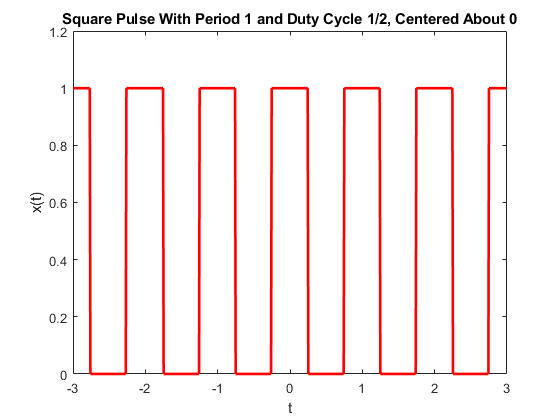
Consider a square wave with period \(T\) and duty cycle of 0.5:
\begin{align} x(t) &= \begin{cases} 1, \quad -\frac{T}{4} \leq t \leq \frac{T}{4}\\ \\ 0, \quad \text{otherwise} \\ \end{cases}, \quad \text{repeats every } T \\ \end{align}
The Fourier coefficients of \(x(t)\) is:
\begin{align} c_n &= \frac{1}{T}\int_{-\frac{T}{2}} ^ {\frac{T}{2}} x(t) e^{-j\omega nt}\, \mathrm{d}t \\ \\ &= \frac{1}{T}\int_{-\frac{T}{4}} ^ {\frac{T}{4}} e^{-j\omega nt}\, \mathrm{d}t \\ \\ &= \frac{e^{-j\omega n (-T/4)} - e^{-j\omega n (T/4)}}{Tj\omega n} \\ \\ &= \frac{e^{j\pi n /2} - e^{-j\pi n /2}}{2\pi jn} \\ \\ &= \boxed{\frac{\sin{\left(\frac{\pi n}{2}\right)}}{\pi n}}, \quad \text{for } n \neq 0\\ \\ c_n &= \boxed{\frac{1}{2}}, \quad \text{for } n = 0 \\ \end{align}
Applying Parseval's theorem:
\begin{align} \frac{1}{T}\int_{-\frac{T}{2}} ^ {\frac{T}{2}} |x(t)|^2\, \mathrm{d}t &= \sum_{n = -\infty}^{\infty}|c_n|^2 \\ \\ \frac{1}{2} &= \left(\frac{1}{2}\right)^2 + 2 \sum_{\substack{n=1 \\ n\ \text{odd}}}^{\infty} \left(\frac{1}{\pi n}\right)^2 \\ \\ 2 \sum_{\substack{n=1 \\ n\ \text{odd}}}^{\infty} \left(\frac{1}{\pi n}\right)^2 &= \frac{1}{4} \\ \\ \sum_{\substack{n=1 \\ n\ \text{odd}}}^{\infty} \left(\frac{1}{n}\right)^2 &= \frac{\pi^2}{8} \\ \end{align}
Therefore, we have result 1:
\begin{equation} \boxed{1 + \frac{1}{3^2} + \frac{1}{5^2} + \frac{1}{7^2} + \dots = \frac{\pi^2}{8}} \end{equation}
We let: \(x = \sum_{n = 1}^{\infty} \frac{1}{n^2}\). Combining this with result 1, we get:
\begin{align} \frac{x}{4} + \frac{\pi^2}{8} &= x \\ \\ \frac{3x}{4} &= \frac{\pi^2}{8} \\ \\ x &= \frac{\pi^2}{6} \\ \end{align}
This completes the proof to the Basel problem:
\begin{equation} \boxed{1 + \frac{1}{2^2} + \frac{1}{3^2} + \frac{1}{4^2} + \frac{1}{5^2} + \dots = \frac{\pi^2}{6}} \end{equation}