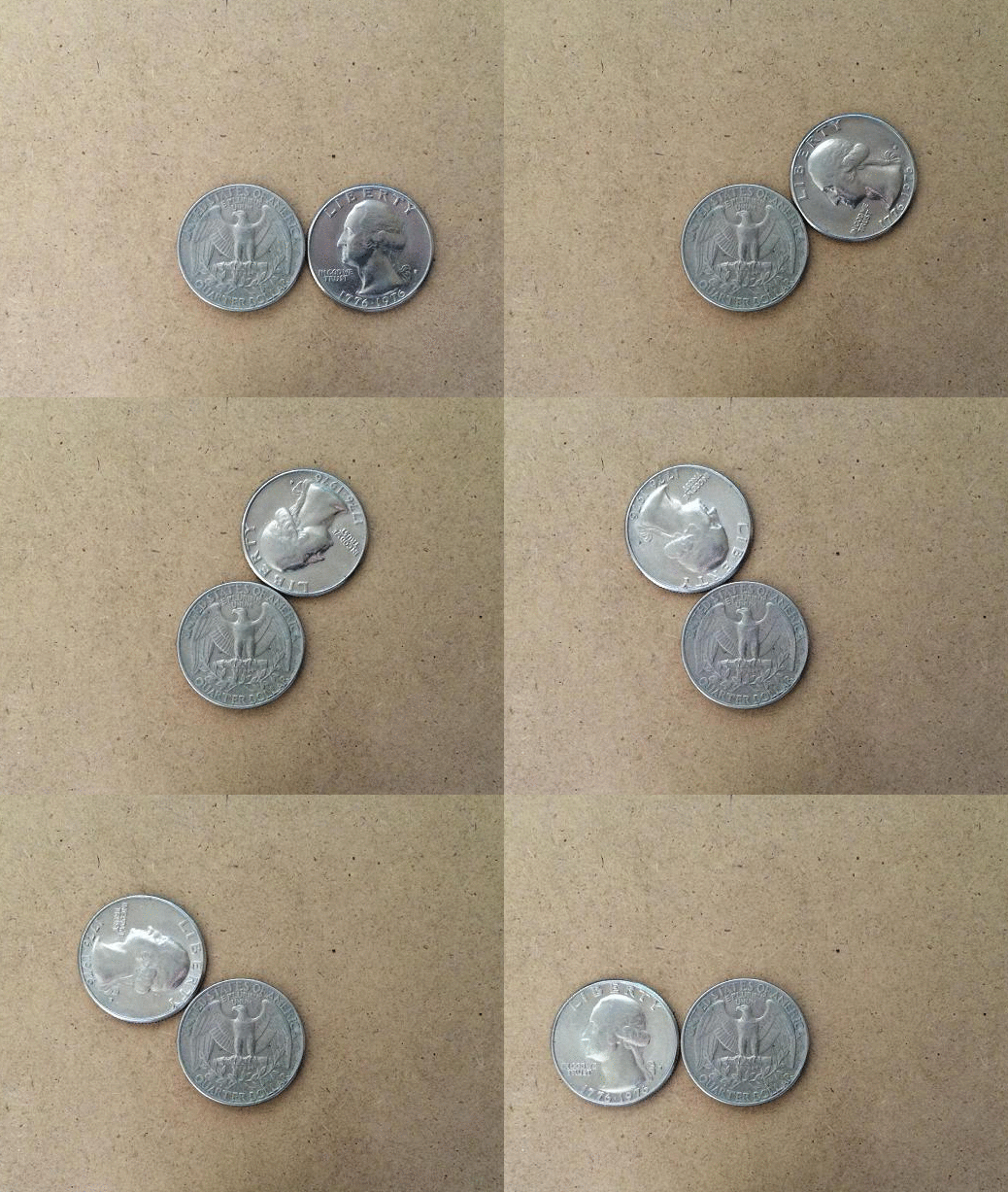
At first glance, the intuitive answer might be, well, one. After all, the rolling coin has a circumference, say c, and it is rolled, without slipping, against another coin with circumference c. This is basically saying how many revolutions does a circle with circumference c make while rolled against a path with length c. Surely, the answer is one?
Well, the actual answer is two. And this seemingly strange result is called the “coin rotation paradox” and that Wikipedia has a short article describing it. Here, I will use math to solve this paradox in the general case and dish out some insights for the general result.
The Setup
In order to consider the general case, we are going to consider two circles with arbitrary radii. Let's first label the rolling circle "1" and the fixed circle "2", and let the former have center \(O_r\) and radius \(r_r\) and the latter with center \(O_f\) and radius \(r_f\), respectively. So now we have a setup where we are letting the rolling circle with a radius \(r_r\) roll, without slipping, about the point \(O_r\), against a fixed circle with radius \(r_f\).
Below is a diagram illustrating the setup.

You may notice in the above diagram, there are four points pointing to the meeting point for both circles. They are: \(R_f\), \(R_r\), \(T\), and \(P\). They are described as below.
- \(R_r\) : fixed point on circle 1. It is always at the bottom of the rolling circle.
- \(R_f\) : fixed point on circle 2. It is always at the top of the fixed circle.
- \(T\) : tangent point between circles 1 and 2 as circle 1 rolls against 2.
- \(P\) : point moving with circle 1 as it moves against circle 2.
Without loss of generality, we let the initial state be such that the bottom of circle 1 is touching the top of circle 2. Therefore, points \(R_f\), \(R_r\), \(T\), and \(P\) are initially the same point. As circle 1 rolls against circle 2, however, those four points begin to separate.
The Roll
When circle 1 rolls against circle 2 without slipping, we get the following as illustrated below.

You may have a lot of questions right now. Let me answer them here.
The key is to consider the arc length \(PR_r\) going through the point \(T\). Obviously this arc length is equal to the sum of \(PT\) and \(T\)\(R_r\), hence equation I. But \(PR_r\) is equal to \(R_f\)\(T\). To see this, recall that circle 1 rolled against circle 2 without slipping, and initially \(P\) and \(R_f\) are the same point (as with \(T\)). So, as \(P\) started moving on circle 1, it must have moved away from \(T\) the same distance as \(T\) has moved away from \(R_f\), since \(T\) changes as circle 1 moves but \(R_f\) is always fixed at the starting point, hence equation II.
For the first part of equation III, we let the angle \(\theta\) be the angle \(R_f\) \(O_f\) \(T\). However, why is the angle \(T\) \(O_f\) \(R_f\) also \(\theta\)? This is due to alternate angles as we have the line segment \(R_f\)\(O_f\) being parallel to \(O_r\)\(R_r\), and since the circles meet at \(T\), \(O_f\)\(T\) is colinear with \(T\)\(O_r\). This means \(O_f\)\(O_r\) is a line segment. Putting the above facts together we have angle \(T\) \(O_f\) \(R_f\) being an alternate angle of angle \(R_f\) \(O_f\) \(T\), and hence angle \(T\) \(O_f\) \(R_f\) is also \(\theta\). Finally, the equation of arc lengths for a circle is \(\theta\) times radius, and hence equation III.
Using distributive law, we obtain equation IV of the derivation, and we label this result as Eqn. 1.
The Analysis
Remember. Arc length \(PTR_R\) represents how far \(P\) has moved (due to circle 1 rolling) from the starting point on circle 1, which is \(R_r\). Circle 1 completes one revolution when \(P\) overlaps with \(R_r\) again (i.e. PT\(R_r\) becomes equal to the circumference of the rolling circle 1). Circle 1 stops rolling when \(\theta\), which is the angle subtending the arc length of the fixed circle, becomes \(2 \pi\), at which point \(T\) is back to \(R_f\).

In equation 3, theta_star represents the angle subtending the arc lengths of the fixed circle \(R_f\)\(T\) when circle 1 completes one full revolution as \(PR_r\) is equal to the circumference of the rolling circle 1. With that equation, we can finally arrive at the answer to the original question, how many revolutions does circle 1 make while going around circle 2 once without slipping?

There you have it. The number of rotations circle 1 makes while travelling one loop agasint circle 2 is N = 1 + (\(r_f\)/\(r_r\)). Letting \(r_f\) = \(r_r\) in the case where the two coins have equal size, you get N = 1 + 1/1 = 1 + 1 = 2. Paradox solved!
For example, if you have a circle with radius 3 rolling against a fixed circle with radius 1, the rolling circle makes N = 1 + (3/1) = 4 revolutions (and not 3).
Intuition and Takeways
It is one thing to see the answer by going through the numbers, but inherently as human beings, we crave to draw a connection to the result with our senses, especially since we have a general case to play around. This section is my take on the general result in equation 5.
TL;DR
When \(r_f\) is much less than \(r_r\), the movement of circle 1 is curvature dominated. When \(r_f\) is much greater than \(r_r\), the movement of circle 1 is rotation dominated.
Why Two Revolutions?
Let's first answer the initial question: why did the coin make two revolutions while going around another coin of the same size once without slipping? The answer is that the path in which the rolling coin took was not a straight line. Rather, it is curved. The curvature of the fixed coin adds to the rotation of the moving coin. In fact, please try to see where the above fact is applied in our math derivations. In the case where \(r_f\) = \(r_r\), the fixed coin's circular curvature adds exactly one revolution to the moving coin's path, and this coupled with the rotation of the moving coin, means that the latter makes two revolutions while rolling around the former.
Limits
Let's consider the general result N = 1 + (\(r_f\)/\(r_r\)) as we shrink or enlarge the fixed circle 2 while keeping \(r_r\) constant. As \(r_f\) gets smaller and smaller, N \(\to\) 1. Why doesn't N go to zero since the fixed circle's path approaches 0? This is because no matter how small the fixed circle gets, it will always be a circle. Therefore, close your eyes for a moment and imaging the rolling circle moving around this almost dot-like circle. The moving circle still rotates! However, it does so because of the curvature of the fixed circle, completing just above one revolution as it rolls around the dot. The rolling circle itself doesn't move much since the rolling path is so short as \(r_f\) \(\to\) 0, but the fixed circle still has curvature equal to one revolution per revolution of the rolling circle, and hence N \(\to\) 1. As \(r_f\) \(\to\) 0, the rotation of the rolling circle becomes dominated by the curvature of the fixed circle.
On the other end, as \(r_f\) \(\to \infty\), we see that N \(\to \infty\) as well. Put it another way, the term \(r_f\)/\(r_r\) gets larger as \(r_f\) gets larger, while the other term, "1", is, well, just 1. As \(r_f\) get very large, we can approximate N = \(r_f\)/\(r_r\). If you squint your eyes really hard, you might see that this is just saying the number of rotations the rolling circle makes is equation to the rolling path / circumference of the rolling circle! This means we can once again apply our "faulty" intutition at the beginning of the puzzle about the two equal-sized coins?!. Absolutely! Imagine you are rolling a coin against the equator of the Earth. The Earth's curve is so large compared to the coin that you may as well be rolling the coin against a straight line (this does NOT prove the Earth is flat, however >:-|). Therefore, as \(r_f\) gets bigger, the movement of the rolling circle becomes dominated by its own rotation.
In summary, as \(r_f\)/\(r_r\) goes to 0, the movement of the rolling circle becomes curvature-dominated. As \(r_f\)/\(r_r\) goes to infinity, the movement of the rolling circle becomes rotation-dominated. The balance point? When \(r_f\) = \(r_r\). Here both curvature and rotation each adds one revolution, and hence the answer to the original question is: 2.