September 26, 2025
In the original puzzle, we are asked the probability of getting a set of tradeable cards with three cards drawn randomly from a pool of 42 cards with 14 of each kind (infrantry, cavalry, and artillery).
First, the denominator for the probability is simply the number of ways to choose 3 cards from a pool of 42 cards, which is \(\binom{42}{3} = 11480\). Next, we consider the cases. First case: all three of the same kind. We have 3 choices in the kind times \(\binom{14}{3} = 364\), which is three cards to choose from for each kind, giving us \(3 \times 364 = 1092\). Next, we consider the case where we are dealt one card from each kind. This is simply \(\binom{14}{1}^3 = 14 \times 14 \times 14 = 2744\), since each choice within a kind is independent of other kinds. Adding the two cases together yields a numerator value of \(1092 + 2744 = 3836\).
Thus, the final probablity is \(\frac{3836}{11480} = \boxed{\frac{137}{410}} \approx 0.334\). That is, you have approximately a 1 in 3 chance of getting a tradeable set with three cards randomly drawn.
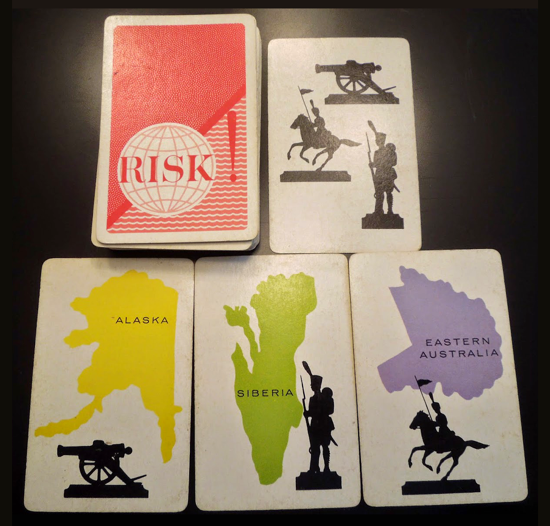
"The full deck of Risk cards also contains two wildcards, which can be used as any of the three types of cards (infantry, cavalry, and artillery) upon trading them in. Thus, the full deck consists of 44 cards.
You must have at least three cards to have any shot at trading them in. Meanwhile, having five cards guarantees that you have three you can trade in.
If you are randomly dealt cards from a complete deck of 44 one at a time, how many cards would you need, on average, until you can trade in three?"
***
Now the cases become much more interesting. In order to making the puzzle appear more solvable, we will take advantage of the fact that the number of cards needed is at least three and at most five. Let \(P_k\) be the probability of acquiring a tradeable set with exactly \(k\) cards, thus, our answer for the expected number of draws is simply:
\begin{align} \boxed{E = 3P_3 + 4P_4 + 5P_5} \end{align}
Where \(P_3 + P_4 + P_5 = 1\).
First, let's look at \(P_3\). Upon close observation, we notice that a set of three cards containing any number of wildcards, even just one, is enough for a tradeable set. This is because a wildcard + two cards of the same kind forms three of a kind, while a wild card + two cards of the different kind can form three cards of different kinds. Both sets are tradeable.
Thus, in order to obtain \(P_3\), we divide the cases up between wildcard hands and no wildcard hands. For the latter, from the original puzzle, we know there are \(3836\) such hands. There are \(\binom{44}{3}\) total possible hands out there, with \(\binom{42}{3}\) containing no wild cards. This gives us \(\binom{44}{3} - \binom{42}{3} = 13244 - 11480 = 1764\) wildcard hands. Thus, the total number of possible tradeable hands is now: \(3836 + 1764 = 5600\).
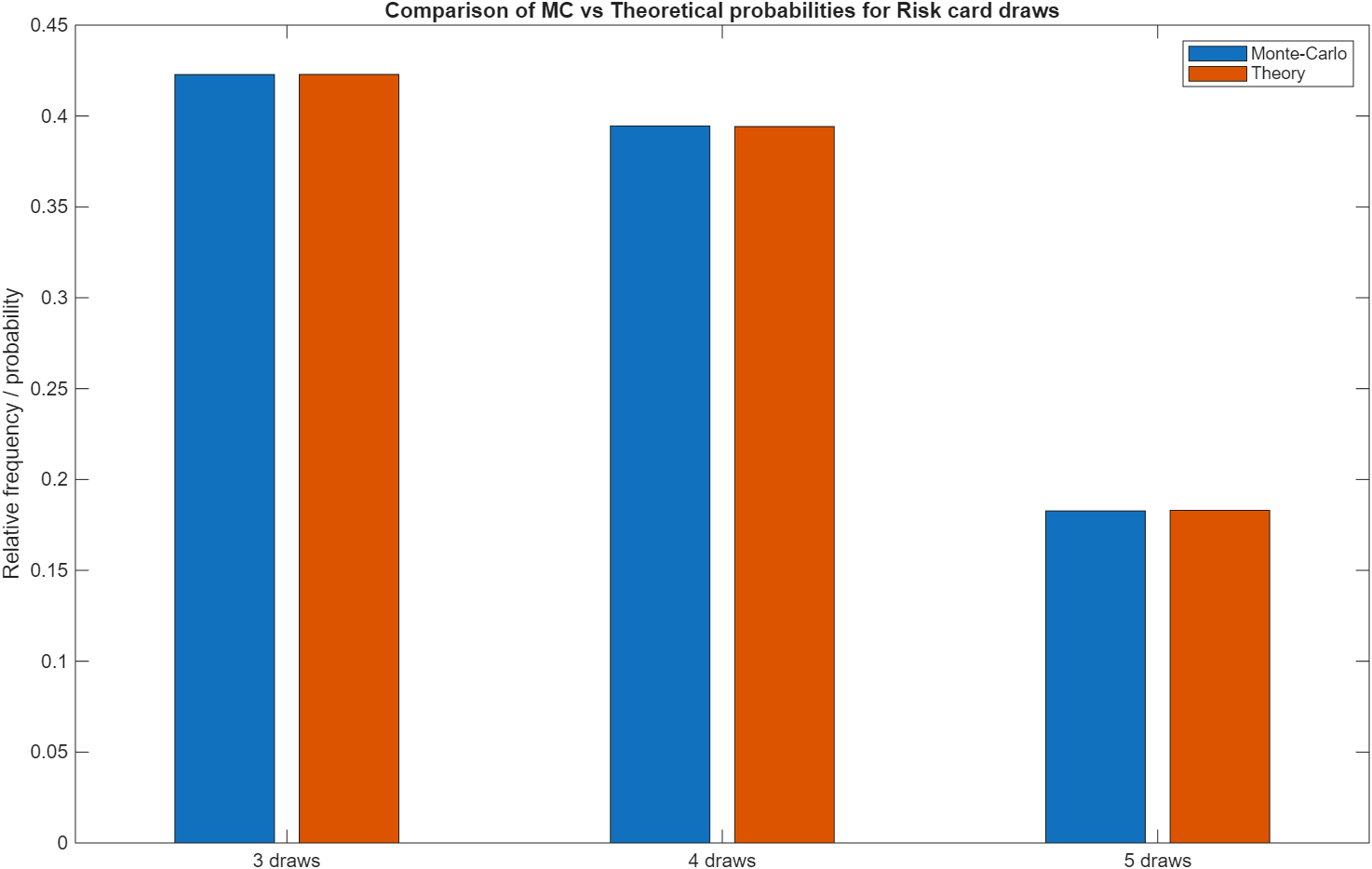
The denominator is \(\binom{44}{3} = 13244\), thus giving us \(P_3 = \frac{5600}{13244} = \boxed{\frac{200}{473}} \approx 0.423\).
For \(P_4\), there are many cases to consider, so it's easier to consider \(P_5\) and obtain \(P_4\) indirectly. For \(P_5\), putting our critical thinking hat on, we realize that the only way to obtain a tradeable set only after five cards are given is if when we have four cards, it's two and two from each of two kinds (e.g. two infrantry + two cavalry). So the probability of that happening is as follows: first we pick two among three kinds which has \(\binom{3}{2} = 3\) ways. Then for each of the chosen kind we independently pick two out of the kinds, so it's \(\binom{14}{2}^2 = 91^2 = 8281\). Putting everything together, there are \(3 \times 8281 = 24483\) desired hands, out of \(\binom{44}{4} = 135751\) possible hands, giving us \(P_5 = \frac{24843}{135751} = \boxed{\frac{3549}{19393}} \approx 0.183\).
Hence, \(P_4 = 1 - P_3 - P_5 = 1 - \frac{200}{473} - \frac{3549}{19393} = \boxed{\frac{7644}{19393}} \approx 0.394\).
Finally, we have:
\begin{align} E &= 3P_3 + 4P_4 + 5P_5 \\ \\ &= 3\left(\frac{200}{473}\right) + 4\left(\frac{7644}{19393}\right) + 5 \left(\frac{3549}{19393}\right) \\ \\ &= \boxed{\frac{72921}{19393}} \\ \\ &\approx 3.76 \: \text{draws} \end{align}
Thus, one expects 3.76 draws on average before immediately arriving at a tradeable set.
I wrote some code in MATLAB to perform Monte-Carlo of the above draws with one million trials, and plotted the relative frequencies of getting tradeable sets after three, four, or five draws. It's pretty close to theory!