October 10, 2025
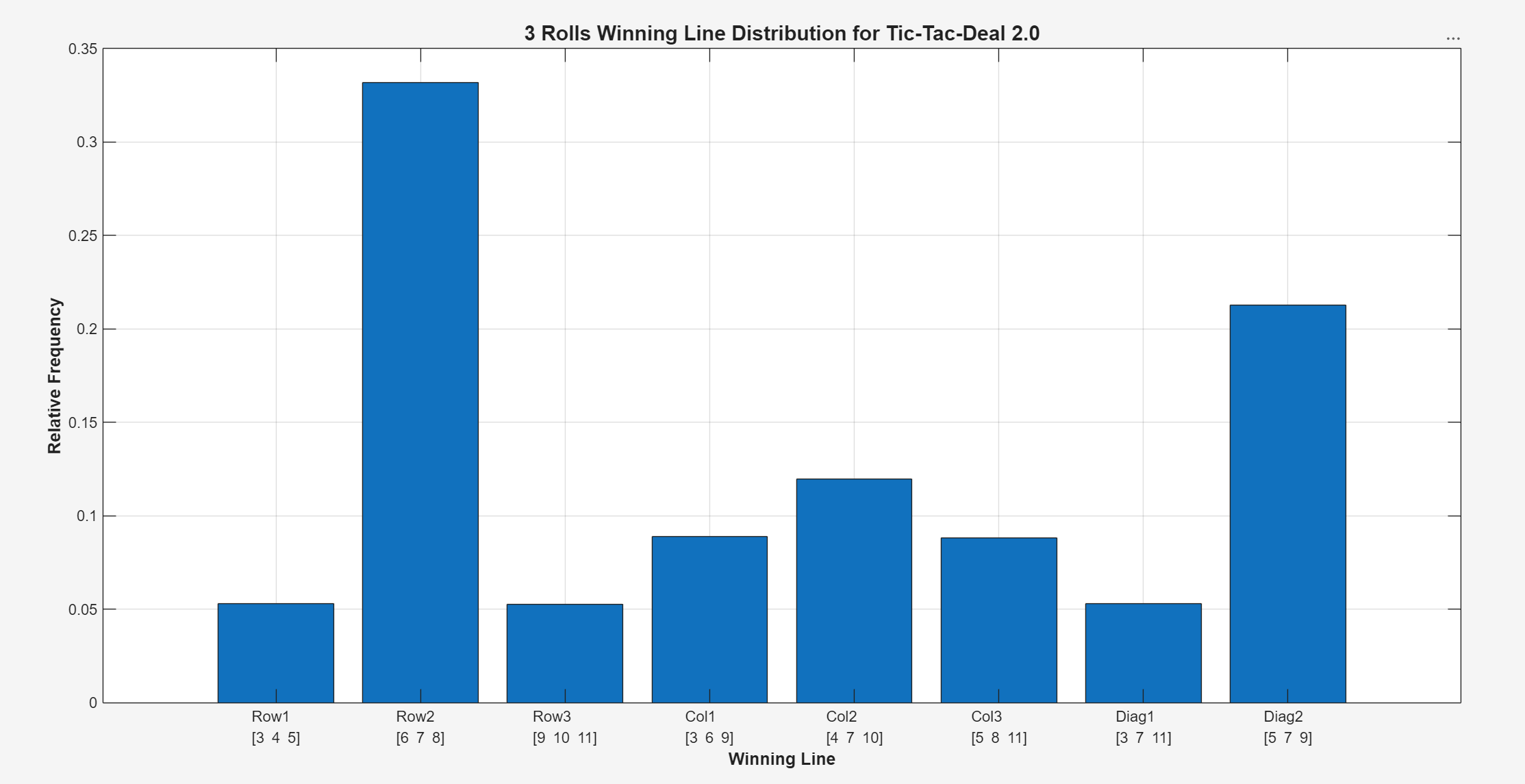
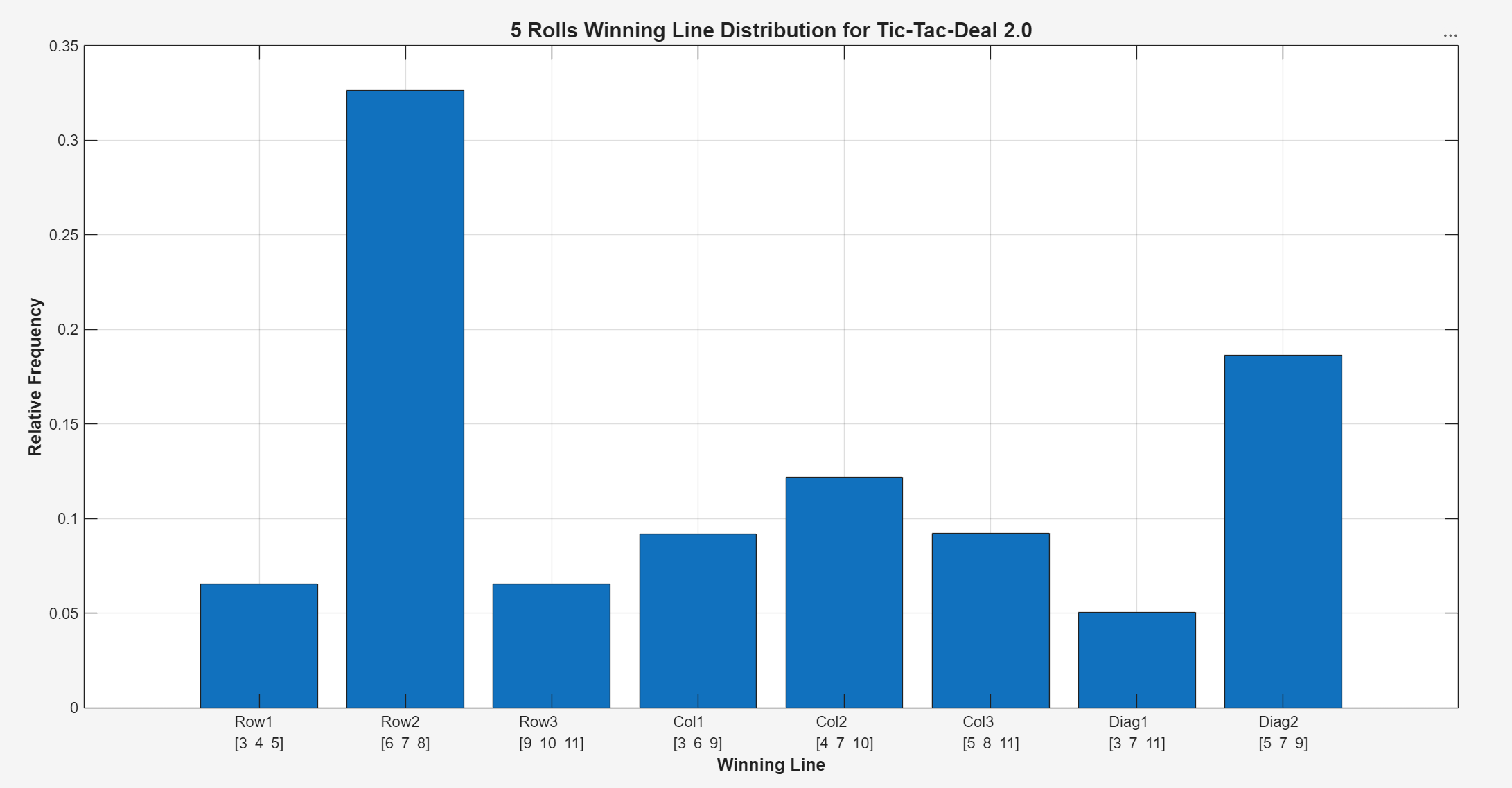
I used Monte Carlo to solve both the original problem and the extra credit, each with 10 million trials. Here is what I found. For the original problem, the probability is 0.0582, and for the extra credit, the probability is 0.3613. I also plotted the relative frequencies of the winning lines (should a winning sequence of rolls be produced) for both three rolls and five rolls) in MATLAB, as seen below respectively:
Not surprisingly, the [6 7 8] (i.e. the middle row) is the most frequent winning line as those rolls are the most likely to happen. However, what is surprising is that the least frequent winning line also involves "7", i.e. the [3 7 11] diagonal. That line is on par in frequency with the [3 4 5] line for the three rolls case, but for the 5 rolls case, it is significantly less frequent than the [3 4 5] winning line, even though the latter doesn't involve the "7" roll, which is the most likely roll. Thus, it appears that the unlikely nature of rolling both a 3 and an 11 needed to make the [3 7 11] winning line offsets the likely roll of the "7".